
Why This Fails So Often Here
On fishing boats working tropical Southeast Asian waters, bilge pumps and bilge line fittings rarely fail from normal use alone. Salt water, constant humidity, sun exposure, fish handling residue, deck impact, and short repair windows all shorten service life. The failure patterns below repeat across fish ports, repair counters, and small yards in Indonesia, Vietnam, Thailand, Malaysia, the Philippines, and nearby island markets. By the time a part fails visibly, the damage has usually been growing for weeks in a place the crew cannot easily see.
The repair team rarely has time for a long technical discussion. So the practical question is not “what is this part called”. It is: what actually failed, what must be replaced with it, and how do we describe it clearly enough to get the right part the first time.
What the Symptoms Usually Tell You
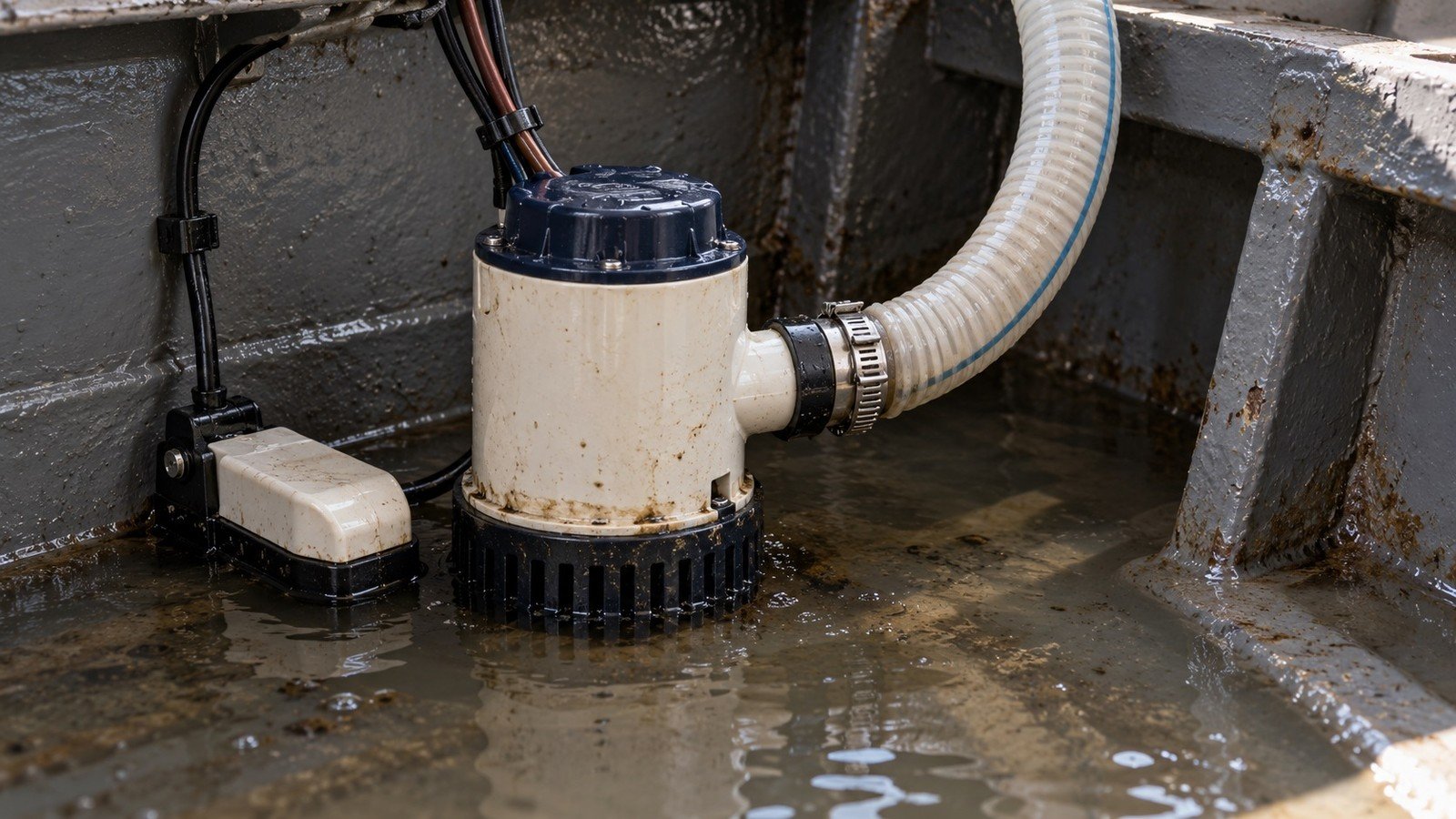
- Bilge water is still rising slowly – the pump runs but moves less water than before. Worn impeller, worn pump head, or a partly blocked strainer is the usual cause. Check the strainer first, then the impeller. Replacement fittings for this line are listed under MARINE pumps and valves.
- The pump runs dry or slurps air – the pick-up or hose is not fully submerged, the hose wall has collapsed, or a hose clamp is loose. Air in the line means no lift, even if the motor is fine. Hose clamps and matching stainless fasteners are usually the cheapest part of the repair.
- Water flows back after the pump stops – the check valve is not sealing. A failed check valve makes the pump cycle again and again, which shortens motor life.
- Pump starts and stops repeatedly – a float switch or automatic sensor is triggering at the wrong level, or the check valve leak is confusing the level logic.
- Burning smell, blown fuse, or a motor that will not restart – water has reached the motor or the wiring connection. Stop using the switch and treat the pump as failed, not intermittent.
Comparison: Symptom, Cause, and What to Check
| Warning sign | Likely failed part | Replace together with |
|---|---|---|
| Slow or weak discharge | impeller, pump head, blocked strainer | strainer, hose clamps |
| Runs dry or slurps air | loose clamp, collapsed hose, air leak at fitting | hose, clamps, hose tail |
| Water flows back | check valve not sealing | check valve, gaskets |
| Short cycling | float switch or sensor | float switch, check valve |
| Burning smell or blown fuse | motor, wiring connection | pump, connectors, fuse holder |
What Must Be Replaced Together
- Check valve – a failed check valve caused the backflow that made the pump cycle; replacing the pump alone repeats the problem.
- Hose clamps – cheap to replace and the most common source of air leaks at the pump outlet.
- Hose – a hose that has collapsed internally cannot be seen from outside but kills pump performance.
- Strainer – a partly blocked strainer is the most overlooked cause of weak discharge.
- Float switch – if the switch triggered erratically, the new pump will inherit the same behaviour.
Replacing only the visibly broken item is the most common reason a repair comes back. Where a part depends on another for alignment, sealing, load transfer, or electrical connection, quote both in the same RFQ. Buyers who stock several boats can review the full range on the CIDMEN product catalog.
Inspection Checklist Before Ordering
- Identify the exact position on the boat and what the part connects to.
- Photograph the failed part from the front, side, and connection area.
- Measure diameter, length, thickness, hole spacing, thread, or voltage as applicable.
- Note the material or finish of the failed part, and whether it corroded, cracked, bent, or wore.
- Record quantity per boat and number of boats to be repaired.
- Note whether the buyer will resell the part or use it in a repair job.
RFQ Details That Prevent a Wrong Order
A useful RFQ for this repair includes: failed part photos, close-up of the connection or sealing surface, approximate measurements, vessel type and size, working position on the boat, material or finish preference, quantity, whether related parts should ship together, destination port, and packing requirements for resale or workshop use.
If the exact model or standard is unknown, say so. A photo with a ruler or a handwritten note is more useful than a guessed part number.
Common Ordering Mistakes
- Ordering by product name only, without the working position or connection type.
- Replacing the failed item but not the worn counterpart that caused the wear.
- Assuming any stainless grade is equal; 304 and 316 behave differently in salt exposure.
- Mixing similar sizes in one carton with no label, which causes wrong picks at the repair counter.
- Guessing a standard or part number instead of sending photos and measurements.
FAQ
How do I know whether a failed part in this group needs replacement or just tightening?
Check for loss of section thickness, pitting, deformation, cracked mounting points, or a connection that no longer holds under normal load. If any of these are visible, replacement is the safer route for a working boat.
Can I replace only the broken item, or must the whole set be replaced?
Often not. The failed part may have worn its counterpart. Quote the working set so the repair does not repeat in a few weeks.
What photos should I send for a replacement match?
One full view, one close-up of the connection or sealing area, one side view showing thickness or profile, and one photo of the installed position. Add a ruler for scale when drawings are not available.
Is 316 stainless always the right choice?
No. 316 is a common choice for exposed saltwater fittings, but galvanized or bronze parts remain practical in specific positions. The decision depends on exposure, load, wear, and maintenance cycle.
Can several part families ship in one order?
Yes. Fasteners, deck fittings, hose fittings, rigging parts, and hatch hardware are commonly combined. Group them clearly by part family in the RFQ.
How should I describe a part I cannot name in English?
Send photos with measurements and describe where it sits on the boat and what it connects to. Application description is usually enough to narrow the match.
Do I need to confirm a standard before ordering?
If the boat or yard requires a specific standard, confirm it in writing. Otherwise send the old part or drawing and let the supplier match by dimensions and function.
To request a quotation for a bilge line repair set, send the failed part photos and measurements through Contact CIDMEN.
Send a Marine Parts RFQ
Share product photos, drawings, material, quantity, and destination port. CIDMEN can match marine hardware, outfitting fittings, and spare parts for fishing boat repair and supply stores.