
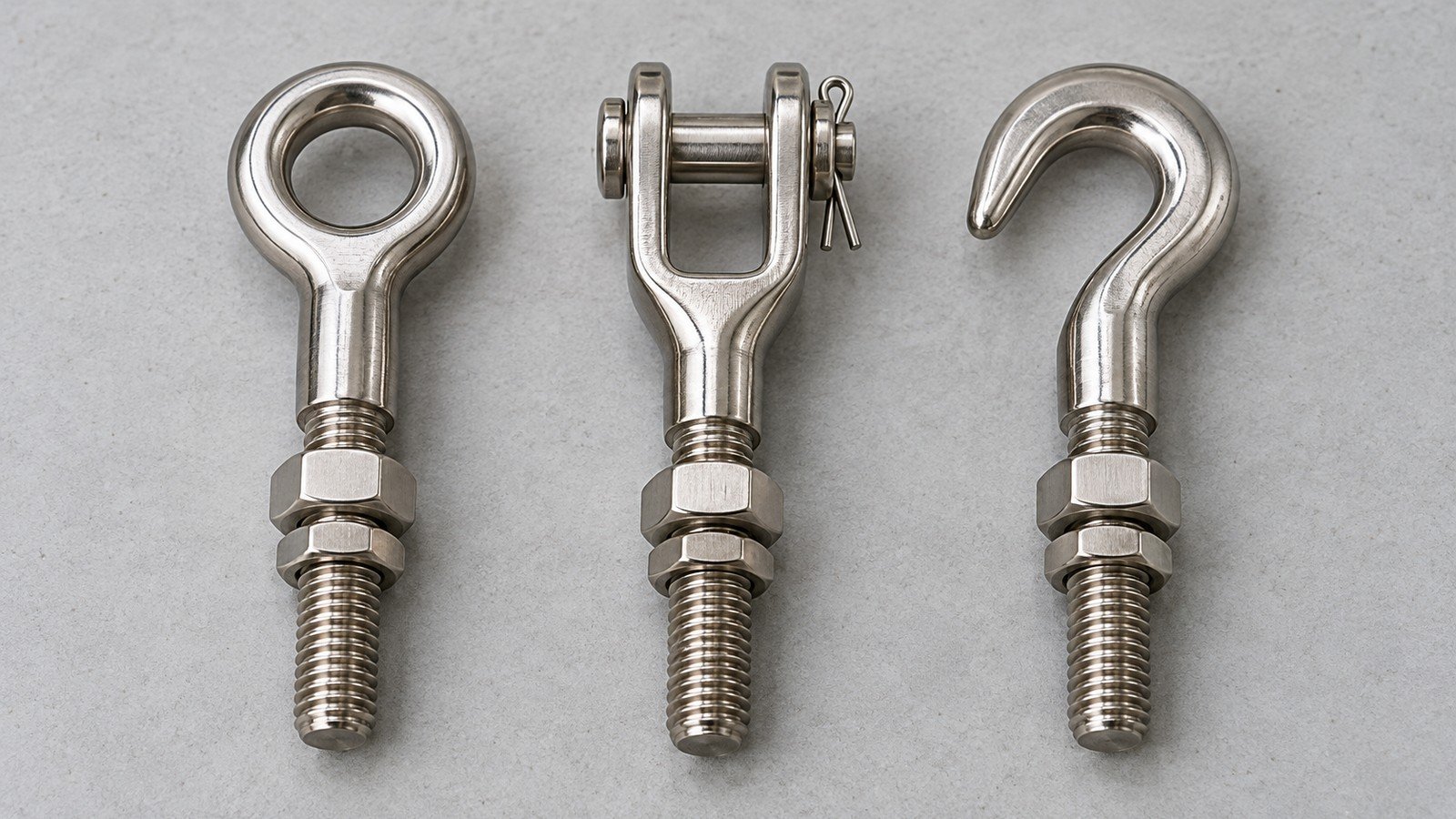
Turnbuckle End Fittings: Eye vs Jaw vs Hook – Which for Your Rigging is a practical sourcing guide for fishing boat repair shops, marine hardware distributors, port-side stores, and small shipyards. It focuses on RFQ preparation, replacement matching, material selection, and mixed-order planning for CIDMEN export customers.
Practical Summary
For this repair situation, the buyer should first confirm the failure symptom, then match the part by material, size, connection type, and working position, and finally group the replacement with its dependent parts so the repair does not need a second order.
Related CIDMEN Product Categories
Why This Fails So Often Here
On fishing boats working tropical Southeast Asian waters, turnbuckles and rigging end fittings rarely fail from normal use alone. Salt water, constant humidity, sun exposure, fish handling residue, deck impact, and short repair windows all shorten service life. The failure patterns below repeat across fish ports, repair counters, and small yards in Indonesia, Vietnam, Thailand, Malaysia, the Philippines, and nearby island markets. By the time a part fails visibly, the damage has usually been growing for weeks in a place the crew cannot easily see.
The repair team rarely has time for a long technical discussion. So the practical question is not “what is this part called”. It is: what actually failed, what must be replaced with it, and how do we describe it clearly enough to get the right part the first time.
What the Symptoms Usually Tell You
1. The jaw end has spread wide enough to slip off the pin – a jaw that no longer closes parallel has been loaded off-axis or forced over a pin one size too large. Sight along the two jaw legs: if a straight edge rocks between them or the pin can be pulled out with the clevis pin in place, the jaw is deformed and must be replaced, not closed up in a vice.
2. The eye shows a groove worn into one side of the opening – an eye fitted direct to a shackle or pin wears where the load sits. A groove you can catch with a fingernail has removed section at the highest-stress point. An eye in that condition, or one that has opened oval, is a fatigue point and should be replaced with an end type that spreads load better, such as a jaw with a pin or a thimble over a rope eye.
3. The hook has straightened or the throat has opened – a hook that opens under load has no safe way back. Straightening means the hook was loaded beyond its working load or was pulled at the point of the hook rather than in the throat. A hook with an open throat, or one without a safety catch where a catch is needed, must be replaced before the next trip.
4. The turnbuckle body threads only partway onto the stud, or threads bind – a stud that will not run in by hand past a few turns has damaged or mismatched thread. Mixed left and right hand threads, or a stud from another maker with a different pitch, will bind and strip under tension. Check that both studs turn the correct way and that the body shows a clear length of thread on both sides when set.
5. Rigging slack cannot be removed because the turnbuckle is already at the end of its thread – a barrel that is fully extended on one side and closed on the other has no adjustment left, and usually means the rigging was made the wrong length or the end fittings were picked without checking the take-up range. Repacking the stud into the body with thread barely engaged is a failure waiting to happen; the fix is a correctly sized assembly.
Comparison: Symptom, Cause, and What to Check
| What you see | Likely cause | What to check or replace |
|—|—|—|
| Jaw legs spread, pin pulls out with the clevis in place | off-axis load or pin forced into an undersized jaw | sight along the legs; replace the end fitting, match the jaw opening to the pin diameter |
| Groove worn into one side of the eye | movement against a shackle or pin in one position | measure the worn section; replace the eye, or move to a jaw or thimbled eye |
| Hook straightened or throat opened | load beyond working load, or load taken at the hook point | retire the hook; check the whole assembly and the load path that caused it |
| Stud binds or will not thread in by hand | damaged or mismatched thread, mixed hand | confirm left and right hand studs; replace stud and body as a matched pair |
| Turnbuckle fully extended, no adjustment left | rigging length or take-up range chosen wrongly | check the required range; replace the assembly rather than setting it on minimal thread |
What Must Be Replaced Together
- The pin or clevis pin that closes the jaw – a jaw end is only as good as the pin through it. A pin one size small lets the jaw work and spread; quote the jaw and its pin together and state the pin diameter.
- The matching end fitting at the other end of the barrel – a turnbuckle usually carries two different ends, for example eye to jaw. Left and right hand thread must be correct on each stud, and a mismatched pair will not tension properly.
- The shackle, chain plate, or deck fitting the end attaches to – a worn or oversized hole at the attachment point makes the eye or jaw work loose and wear in the same spot. Inspect the hole diameter and the bearing face in the same job.
- The thimble if the eye takes rope or wire – an eye bearing directly on wire without a thimble cuts the strands. Renew the thimble with the fitting, and match the thimble size to the rope or wire diameter.
- The wire rope clips and the wire termination – a new turnbuckle fitted onto a tired termination or re-used clips does not restore the rigging. Check the termination and re-make it if strands are crushed, slipped, or rusty.
Replacing only the visibly broken item is the most common reason a repair comes back. Where a part depends on another for alignment, sealing, load transfer, or electrical connection, quote both in the same RFQ.
Inspection Checklist Before Ordering
- Identify the exact position on the boat and what the part connects to.
- Photograph the failed part from the front, side, and connection area.
- Measure diameter, length, thickness, hole spacing, thread, or voltage as applicable.
- Note the material or finish of the failed part, and whether it corroded, cracked, bent, or wore.
- Record quantity per boat and number of boats to be repaired.
- Note whether the buyer will resell the part or use it in a repair job.
RFQ Details That Prevent a Wrong Order
A useful RFQ for this repair includes: failed part photos, close-up of the connection or sealing surface, approximate measurements, vessel type and size, working position on the boat, material or finish preference, quantity, whether related parts should ship together, destination port, and packing requirements for resale or workshop use.
If the exact model or standard is unknown, say so. A photo with a ruler or a handwritten note is more useful than a guessed part number.
Common Ordering Mistakes
- Ordering by product name only, without the working position or connection type.
- Replacing the failed item but not the worn counterpart that caused the wear.
- Assuming any stainless grade is equal; 304 and 316 behave differently in salt exposure.
- Mixing similar sizes in one carton with no label, which causes wrong picks at the repair counter.
- Guessing a standard or part number instead of sending photos and measurements.
FAQ
When should I use an eye end instead of a jaw end?
An eye end suits a fixed attachment where the fitting sits over a shackle, pin, or shackle bolt and the load line stays in one plane. A jaw end is better where the fitting must open to be fitted or removed, and where the pin can be properly sized. The practical rule is: eye where it stays on, jaw where it has to come off, and never a jaw where the pin is undersized.
Are hook ends safe for standing rigging?
A hook is the least secure of the three for a permanent stay. It can open under load, it can be pulled off at the point of the hook, and it needs a safety catch that is often missing or not closed. For stays and shrouds a jaw or eye with a proper pin is the better choice; hooks are more suited to temporary lines and where quick release matters.
My turnbuckle will not tension the rigging any further. What is wrong?
Most often the assembly is already at the end of its take-up range, which points to the stay or the fitting length being wrong rather than the turnbuckle. Check how much thread is showing at both studs. A turnbuckle left with minimal thread engaged is not a repair; the correct fix is to re-measure the rig and fit an assembly with the right range.
Can I replace just one end of a turnbuckle?
Only if you can confirm the thread hand, pitch, and stud size match the existing barrel. Mixed parts from different makers commonly bind or strip. In practice it is safer to quote the complete assembly with both ends, because the barrel and studs are matched and the two ends are chosen for the job.
What is the difference between left and right hand thread, and why does it matter?
A turnbuckle works because one stud has a left hand thread and the other a right hand thread, so turning the body shortens or lengthens both ends at once. If both studs are the same hand, the body will not adjust and will simply unscrew one end. Confirm the hand on each stud when ordering, and mark the assembly so the crew does not swap them.
How do I know whether a failed part in this group needs replacement or just tightening?
Check for loss of section thickness, pitting, deformation, cracked mounting points, or a connection that no longer holds under normal load. If any of these are visible, replacement is the safer route for a working boat.
Can I replace only the broken item, or must the whole set be replaced?
Often not. The failed part may have worn its counterpart. Quote the working set so the repair does not repeat in a few weeks.
What photos should I send for a replacement match?
One full view, one close-up of the connection or sealing area, one side view showing thickness or profile, and one photo of the installed position. Add a ruler for scale when drawings are not available.
Is 316 stainless always the right choice?
No. 316 is a common choice for exposed saltwater fittings, but galvanized or bronze parts remain practical in specific positions. The decision depends on exposure, load, wear, and maintenance cycle.
Can several part families ship in one order?
Yes. Fasteners, deck fittings, hose fittings, rigging parts, and hatch hardware are commonly combined. Group them clearly by part family in the RFQ.
How should I describe a part I cannot name in English?
Send photos with measurements and describe where it sits on the boat and what it connects to. Application description is usually enough to narrow the match.
Do I need to confirm a standard before ordering?
If the boat or yard requires a specific standard, confirm it in writing. Otherwise send the old part or drawing and let the supplier match by dimensions and function.
Prepare a Clear RFQ
For faster quotation, send product names, photos or drawings, key dimensions, material preference, quantity, vessel application, destination, and any packaging or labeling needs.
Contact CIDMEN or use the Inquiry Basket to share your mixed marine hardware requirement.
FAQ
References and Related Reading
- CIDMEN Products: https://cidmen.com/products/
- CIDMEN Marine Hardware: https://cidmen.com/products/marine-hardware/
- CIDMEN Marine Fasteners: https://cidmen.com/products/marine-hardware/marine-fasteners/
- CIDMEN Rigging Accessories: https://cidmen.com/products/marine-hardware/rigging-accessories/
- CIDMEN Mooring Equipment: https://cidmen.com/products/marine-outfitting/mooring-equipment/
- CIDMEN Anchoring Equipment: https://cidmen.com/products/marine-outfitting/anchoring-equipment/
- CIDMEN Marine Pumps & Valves: https://cidmen.com/products/marine-electrical-mechanical/marine-pumps-valves/
- CIDMEN Marine Lighting: https://cidmen.com/products/marine-electrical-mechanical/marine-lighting/
Send a Marine Parts RFQ
Share product photos, drawings, material, quantity, and destination port. CIDMEN can match marine hardware, outfitting fittings, and spare parts for fishing boat repair and supply stores.